
TL;DR: Key takeaways
• Most institutions treat credential issuance as an administrative task. The ones generating the most value from their programs treat it as a strategic touchpoint and their digital credentials analytics tell exactly what that difference produces.
• This guide documents the real business impact of verifiable digital credentials across five dimensions, with numbers from BCdiploma’s client base
A degree issued. A credential sent. File closed. For most institutions and training providers, that’s where the story ends. But for the organizations that have rethought what a credential can do, it’s where the real return begins. This guide documents what that return actually looks like, with data.
The question most organizations aren’t asking
Every year, thousands of institutions and training providers invest in curriculum development, faculty, facilities, and marketing and then issue a static document at the end of it.
The shift from static credential to verifiable digital credential is not primarily a technological upgrade. It is a strategic reframing of what the credentialing moment can produce for the graduate, for the institution, and for the program’s long-term growth.
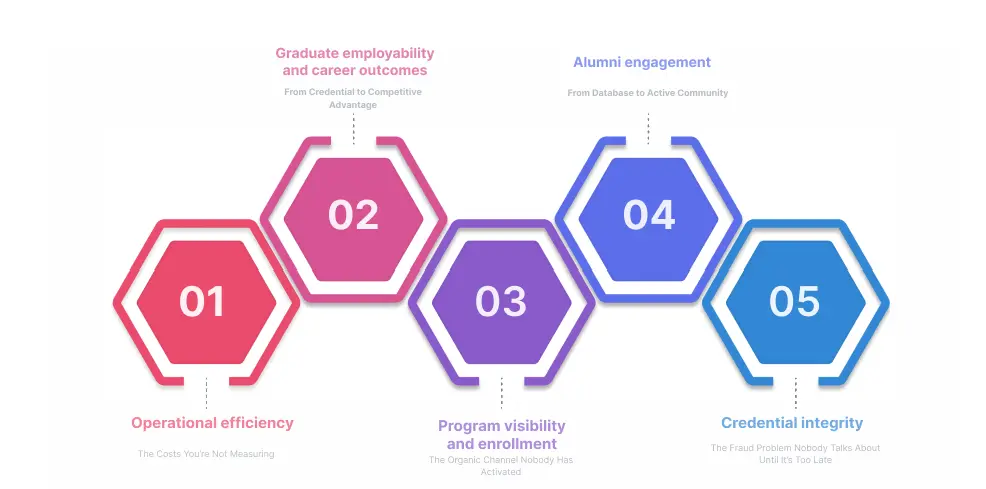
This guide documents what that shift looks like in practice, across five dimensions:
- Operational efficiency
- Graduate employability and career outcomes
- Program visibility and enrollment
- Alumni engagement
- Credential integrity.
Access the summary table directly.
Each section combines market data with concrete results from institutions that have already made the move. Want the full strategic picture? Our 2026 Executive Guide: Major Trends Transforming Skills Recognition maps the 3 core gaps crippling education and hiring today, the 3 trends defining the future, and a concrete roadmap for your team. Download it free.
Part One: Operational Impact; The Costs You’re Not Measuring
The baseline most organizations accept without questioning
Before examining what digital credentials can produce, it is worth mapping what the current process actually costs because most institutions have never done this calculation properly.
The direct costs of paper-based credentialing; printing, postage, physical storage are visible and already being reduced across the sector. The indirect costs are far less visible, which is precisely why they persist.
In most higher education institutions and training providers, credential issuance involves: data extraction from a Student Information System or LMS, manual formatting and template management (often requiring IT involvement for any change), individual or batched sending, error correction, duplicate handling, and ongoing verification responses to recruiter and employer inquiries. Each of these steps absorbs time from staff who have higher-priority work to do.
The aggregate cost of this process rarely appears in any budget line because it is absorbed across departments, attributed to general operations, and never totalled. Until someone totals it.
What the data shows
- Montpellier Business School had a credentialing process that worked until it was measured. With over 4,000 students and four degree programs, the time invested in responding to recruiter verification requests, reissuing lost diplomas, and producing pre-graduation attestations had accumulated to 110 hours per year. After implementing BCdiploma, that figure dropped to 2 hours; a 98% reduction in time spent on credentialing activities. Beyond the time saved, graduates no longer waited up to nine months for their paper diploma to arrive while trying to enter the job market.
- CEMS, the global alliance of elite business schools ranked in the top 10 of the 2025 QS Rankings, saved 15 man-days annually by transitioning from a manual, paper-based certification system to BCdiploma’s fully digital solution; a figure that represents real staff capacity redirected toward strategic work.
- The Eduservices Group (10 schools including Pigier) approached the problem at group scale: 70,000+ certificates issued across 10 schools, with 98% time saved in credentialing management and issuance, and €200,000 saved by consolidating the credentialing process across the whole group.
- The University of Toronto School of Continuing Studies took the calculation even further: 6,000 micro-credentials issued, 170 workdays saved, and $170,000 in overhead cost reduction — turning what had been a manual, labor-intensive issuance process into a fully automated system integrated with their existing infrastructure.
- CCI France, issuing CLOE language certifications across 80+ study centers and 700 training partners, achieved 90% time savings in the certificate issuance process and in the words of the program coordinator: “I hardly need to intervene in certificate management anymore.”
- AFNOR Certification, a benchmark player in professional and systems certification, streamlined its operations by digitizing 15,000 certificates using BCdiploma’s API integration. Moving away from manual data entry and industrial plastic card printing resulted in a 50% productivity gain, cutting credential issuance time in half for their managers. Furthermore, operating under strict ISO/IEC 17024 standards and COFRAC audits, the blockchain solution ensures full traceability, real-time status updates (renewals/suspensions), and automates mandatory compliance reporting for France Compétences.
The pattern across these organizations is consistent: when credential issuance is properly measured, the hidden cost is significant. When it is automated, the savings are immediate and compound with scale.

Want to know what this looks like for your institution? Calculate your ROI; Estimate your time savings, cost reduction, and additional revenue generated through credential sharing based on your actual issuance volume and program type.
| Institution | Context | Key result |
|---|---|---|
| Montpellier Business School | 4,000+ students, 4 degree programs | 110h → 2h/year · 98% time reduction |
| CEMS | Global alliance, top 10 QS 2025 | 15 man-days saved annually |
| Eduservices Group | 10 schools, 70,000+ certificates | €200,000 saved · 98% time saved |
| University of Toronto SCS | 6,000 micro-credentials | 170 workdays saved · $170,000 overhead reduction |
| CCI France / CLOE | 80+ centers, 700 training partners | 90% time savings in issuance process |
Part Two: Graduate Employability; From Credential to Competitive Advantage
The market has moved; most institutions haven’t caught up
The shift in how employers hire graduates is structural, not cyclical. Skills-based hiring has moved from a trend to a baseline: according to Workday’s 2025 research, 96% of companies have now adopted skills-based hiring practices. The implication for institutions is direct: a diploma that says “graduated” is no longer sufficient evidence of what a candidate can actually do.

What employers increasingly need and what graduates increasingly need to show is verified, specific, portable proof of competence. Not a credential that lives in a drawer. A credential that lives on LinkedIn, in a recruiter’s inbox, and on a profile that follows the graduate through their entire career.
The gap between what a paper diploma communicates and what a verifiable digital credential communicates is not cosmetic. It is the difference between a document that attests to completion and a document that proves specific, verified, employer-readable competencies; instantly, without any intermediary.
What the data shows
- Montpellier Business School frames the employability impact directly: before BCdiploma, graduates waited up to nine months between their graduation jury and receiving their paper diploma; a period during which they needed to apply for jobs and could not yet prove their degree. After implementation, graduates could share their digital credential the day after the graduation jury. The employability gap the window where a graduate exists but cannot prove it closed to zero.
- EDHEC Business School, with 55,000 alumni across 127 countries, faced a specific challenge at the intersection of employability and operations: a constant influx of requests from recruiters and employers seeking diploma verification, coupled with alumni requests for reissuance of lost diplomas, was imposing an additional workload on the Registrar team. After BCdiploma implementation, three quarters of EDHEC graduates now actively use the digital diploma certificate, a adoption rate that reflects genuine utility, not passive receipt.
- The University of Lille has issued over 80,000 blockchain certificates across 700 diploma types at a rate of approximately 20,000 per year; at industrial scale, with each credential verifiable by any recruiter, anywhere, without contacting the institution.
For training providers specifically, the employability proof dimension has become a commercial differentiator. Corporate training buyers and OPCO funding bodies increasingly require not just proof of completion, but proof of competency acquisition. A verifiable credential that documents specific skills; timestamped, tamper-proof, shareable with one click provides exactly that documentation in a format that works for the learner’s career and the provider’s renewal conversations.
Finally, according to the 2026 LinkedIn Talent Report, 90% of Chief People Officers state that their organizations will increasingly organize teams based on the skills needed rather than job titles, with 90% expressing a critical need for real-time skills visibility.
For training providers, issuing a generic, catch-all paper certificate has become a commercial handicap. Conversely, providing a verifiable digital credential that precisely details each acquired skill tamper-proof and actionable in a single click delivers the immediate visibility that corporate training buyers now demand to drive their projects forward.
Part Three: Program Visibility and Enrollment; The Organic Channel Nobody Has Activated
Where the enrollment decision is now being made
Student and learner behavior has shifted in ways that most institutions’ marketing strategies have not yet absorbed. Before choosing a program, prospective students no longer start with the institution’s website or brochure. They go to LinkedIn to see where graduates work, what roles they hold, how quickly they got there, and how the institution presents its alumni in the professional world.
This is not a marginal behavior. It is the primary research channel for a generation of learners who have grown up evaluating every significant decision through social proof. The implication is uncomfortable: the most credible marketing asset an institution has is not its own content, it is its graduates’ visible, verifiable career trajectories.
This is the channel that most institutions have not activated. Not because the asset doesn’t exist, but because the infrastructure to make it visible doesn’t.
What the data shows
60% of graduates and learners who receive a verifiable digital credential share it publicly on LinkedIn and professional networks. This figure represents a structural behavior, not a campaign result; graduates share their achievement at the moment of receipt, spontaneously, because the credential is designed to be shareable.

Each share contains the institution’s branding, a direct link to the program page, and the specific competencies the graduate acquired. It reaches their professional network which typically includes colleagues, managers, and peers in the same industry and career stage as future learners.
The enrollment math is straightforward: a graduating class of 500, with a 60% share rate, generates 300 organic brand touchpoints in exactly the professional networks where future learners and their employers are active. Each touchpoint is hosted on the graduate’s profile permanently not for the duration of a campaign, but for as long as that graduate maintains a professional presence. Unlike a paid campaign, digital credentials analytics allow institutions to measure exactly how many times each credential is viewed and verified, turning organic graduate sharing into a trackable enrollment signal.
Montpellier Business School observed this dynamic directly: the institution was glad to see digital credentials being shared on LinkedIn, noting that it creates a positive dynamic and image, and is proud to provide an innovative service of immediate use that reinforces the employability of graduates, especially internationally thanks to a multilingual English/French version.
The ranking dimension reinforces this: since 2024, QS has restructured its methodology to include Employment Outcomes as a dedicated indicator; making graduate employability a measurable, weighted component of global rankings for the first time. Institutions that can document and demonstrate graduate outcomes are directly better positioned in this new framework. Those that cannot are exposed.
Part Four: Alumni Engagement; From Database to Active Community
The problem with most alumni strategies
Alumni engagement is a long-standing priority for higher education institutions; for fundraising, mentoring, industry connections, and institutional reputation. The challenge has always been the same: how do you maintain a relationship with graduates after they leave?
What the data shows
The insight from several BCdiploma use cases is that the digital credential solves the alumni engagement adoption problem; not by asking graduates to do something extra, but by giving them something immediately useful at exactly the right moment.
- IAE Nantes, after integrating BCdiploma with its AlumnForce alumni platform, saw the student activation rate on the alumni platform increase by 20 percentage points. The implementation of BCdiploma and its integration with AlumnForce automated the issuance of verifiable, one-click secure diploma attestations, facilitating professional processes and visa acquisition for students which in turn drove engagement with the alumni platform itself.
- Sciences Po Bordeaux achieved a result that most alumni platforms can only aspire to: by automatically integrating digital diploma attestations into AlumnForce profiles immediately following the jury’s decisions, the institution reached a 94% student activation rate on the alumni platform with 14,000+ diploma attestations issued. Alumni engage because the credential is already waiting for them on the platform, immediately useful for job applications, visa processes, and professional verification.
The mechanism is consistent: when the credential is the entry point to the alumni ecosystem not a reason to visit it later, activation rates follow. The credential creates the first touchpoint. The alumni relationship builds from there.
Alumni donations represent 26% of all philanthropic funds raised by higher education institutions according to CASE, and contributes directly to the creation of professional opportunities for current students and graduates. The institutions that have solved the activation problem with BCdiploma are not spending more on alumni outreach. They are issuing a better credential at graduation and letting the credential do the first step of the engagement work for them.
Part Five: Credential Integrity; The Fraud Problem Nobody Talks About Until It’s Too Late
A growing and underestimated risk
Diploma fraud is not a theoretical risk. It is a documented, growing operational challenge for institutions, employers, and certification bodies and one that static documents and paper diplomas are structurally incapable of addressing.
The cost of a fraudulent credential slipping through is asymmetric: for the individual who presents it, the risk is relatively low. For the institution whose brand it carries, the reputational and legal consequences can be severe. For the employer who relies on it, the operational impact is direct.
Recruiters and HR teams cannot verify a paper diploma at scale. They receive hundreds of applications, each with credentials in different formats, from different institutions, in different countries. The practical result is that verification rarely happens and fraudulent credentials circulate far more freely than institutions acknowledge. Verifiable digital credentials change this equation entirely: beyond eliminating forgery, they generate digital credentials analytics that give institutions real-time visibility into who is verifying, how often, and from which sectors turning a passive integrity safeguard into an active source of employer engagement data.
For organizations operating in highly regulated sectors, credential integrity is a legal obligation. Subject to annual COFRAC audits and operating in strict compliance with the ISO/IEC 17024 standard, AFNOR Certification uses BCdiploma’s blockchain certificates to guarantee full traceability, manage validity periods, and enable real-time credential suspension. This strict compliance is further enhanced by the automation of the mandatory “Accrochage Certificateur” (regulatory data synchronization) required by France Compétences for Specific Register (RS) qualifications.
What verifiable credentials change and what the data shows
A blockchain-secured verifiable credential cannot be forged, altered, or replicated. It is issued in a single, unique copy, timestamped on a decentralized ledger, and verifiable by any employer or institution with a single click without contacting the issuing organization, without a third-party login, and without any additional process.
BCdiploma’s patented technology, ensures that each credential is tied to the issuing institution’s verified identity making it impossible to create a convincing forgery even with access to the visual design.
Promotrans, the leading French training provider for transport and logistics professionals, operates at a scale that makes credential integrity a structural concern: 56,000 people certified and trained annually across 35 training centers throughout France, delivering 5.6 million hours of training per year. At that volume, manual verification is operationally impossible and the risk of fraudulent certifications circulating in a sector where professional qualifications carry safety implications is not abstract. BCdiploma’s implementation addressed both the operational burden of verification and the integrity risk simultaneously.
ETS Global, the organization behind the TOEIC language certification recognized in over 160 countries, chose BCdiploma to digitize the TOEIC Score Report, a credential whose value depends entirely on its verifiability and fraud-resistance. Results are now available faster and accessible with a single click, with the same blockchain-backed security that protects BCdiploma credentials across all client institutions.
The fraud prevention dimension is not a secondary benefit of verifiable credentials. For institutions operating at scale, in regulated sectors, or with internationally mobile graduates, it is a primary one and one that static documents will never be able to provide.
Results across all five dimensions: a reference summary
| Dimension | Key metric | BCdiploma client evidence |
|---|---|---|
| Operational efficiency | Up to 98% reduction in credentialing time and costs | Montpellier BS · Eduservices · University of Toronto · CCI France · CEMS |
| Graduate employability | Credential available day after jury · verifiable in 1 click | Montpellier BS (0-day gap) · EDHEC (75% active usage) · University of Lille (80,000+ credentials) |
| Program visibility | 60% of graduates share credential on LinkedIn | BCdiploma platform data · Montpellier BS LinkedIn sharing observed |
| Alumni engagement | Up to 94% alumni platform activation rate | Sciences Po Bordeaux (94%) · IAE Nantes (+20 points) |
| Credential integrity | Blockchain-secured · tamper-proof · single-click verification | Promotrans (56,000 certified/year) · ETS Global / TOEIC · patented across 8 regions |
Verification as a measurable signal
Beyond fraud prevention, credential verification events generate a data signal that most institutions have never had access to: who is checking their graduates’ credentials, how often, and from where.
Each time a recruiter or employer verifies a BCdiploma credential, that event is recorded providing institutions and training providers with real evidence of employer engagement with their graduate pool. This signal is qualitatively different from satisfaction surveys or NPS scores. It is direct, behavioral proof that the credential is being used in the hiring process and that the institution’s graduates are actively competing in the job market with a verifiable advantage.
What separates the institutions that have made this shift
Looking across BCdiploma’s client base from Stanford and the University of Toronto to Montpellier Business School and CCI France; the institutions that have made this shift share one characteristic: they stopped treating credential issuance as a purely administrative endpoint and started treating it as a strategic touchpoint.
The credential is the last thing an institution gives a learner. It is the first thing a recruiter sees. It is the proof point a future student’s parent looks for on LinkedIn before writing the tuition check.
The institutions that have recognized this and built the infrastructure to make that touchpoint count, are generating returns across all five dimensions, simultaneously, with every graduating class.
The window for differentiation is still open. The credential visibility gap between institutions that have made this move and those that haven’t is growing. The question is not whether to close it. It is when.
Why should an organization choose the BCdiploma solution?
BCdiploma helps higher education institutions and training organizations automate credential issuance, eliminate manual processes, and issue verifiable digital diplomas and certificates at scale. Institutions using BCdiploma have reduced credential management time and costs by up to 90%.
Want to see what this looks like for your organization? Schedule a meeting with our team.